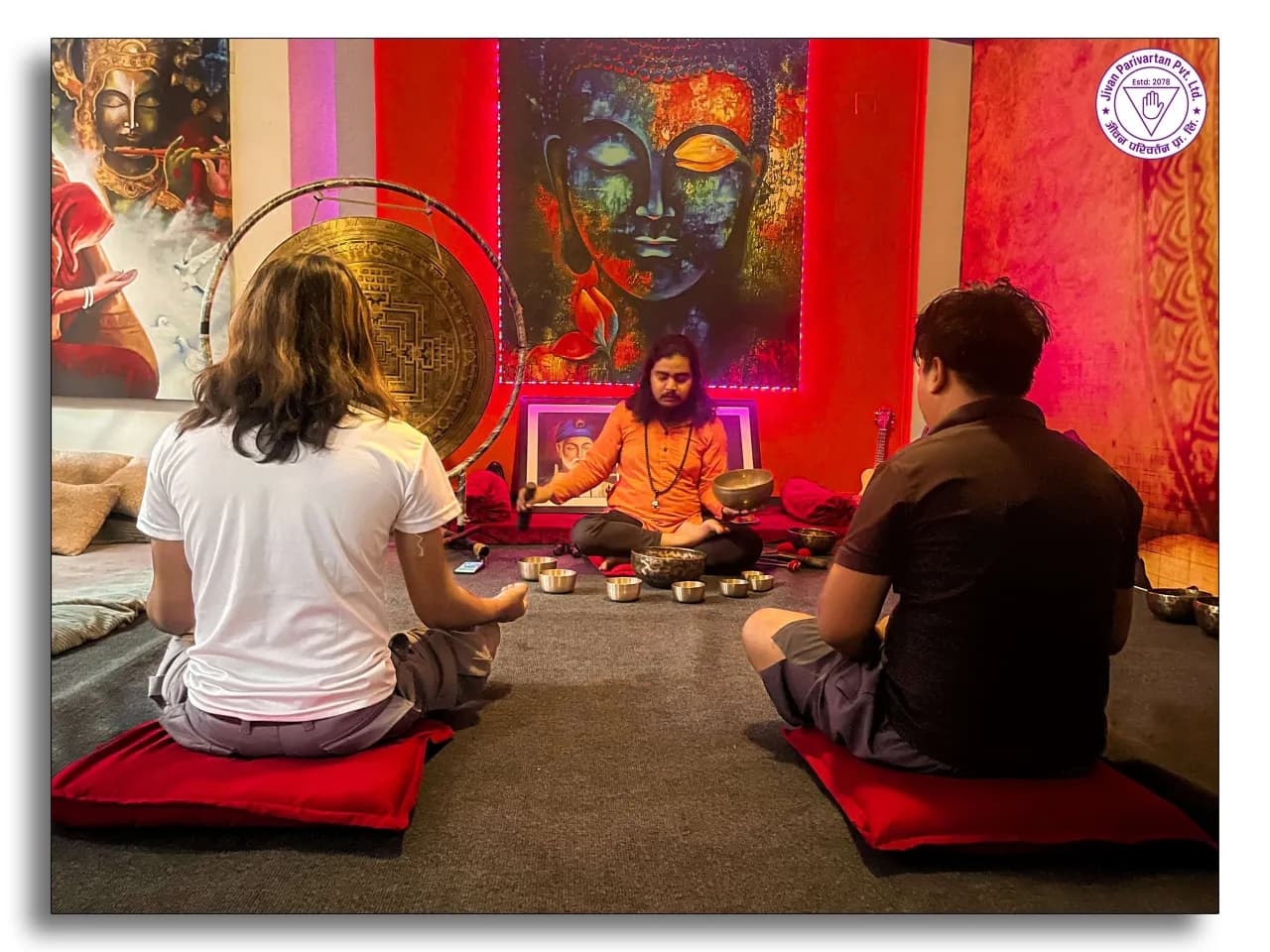
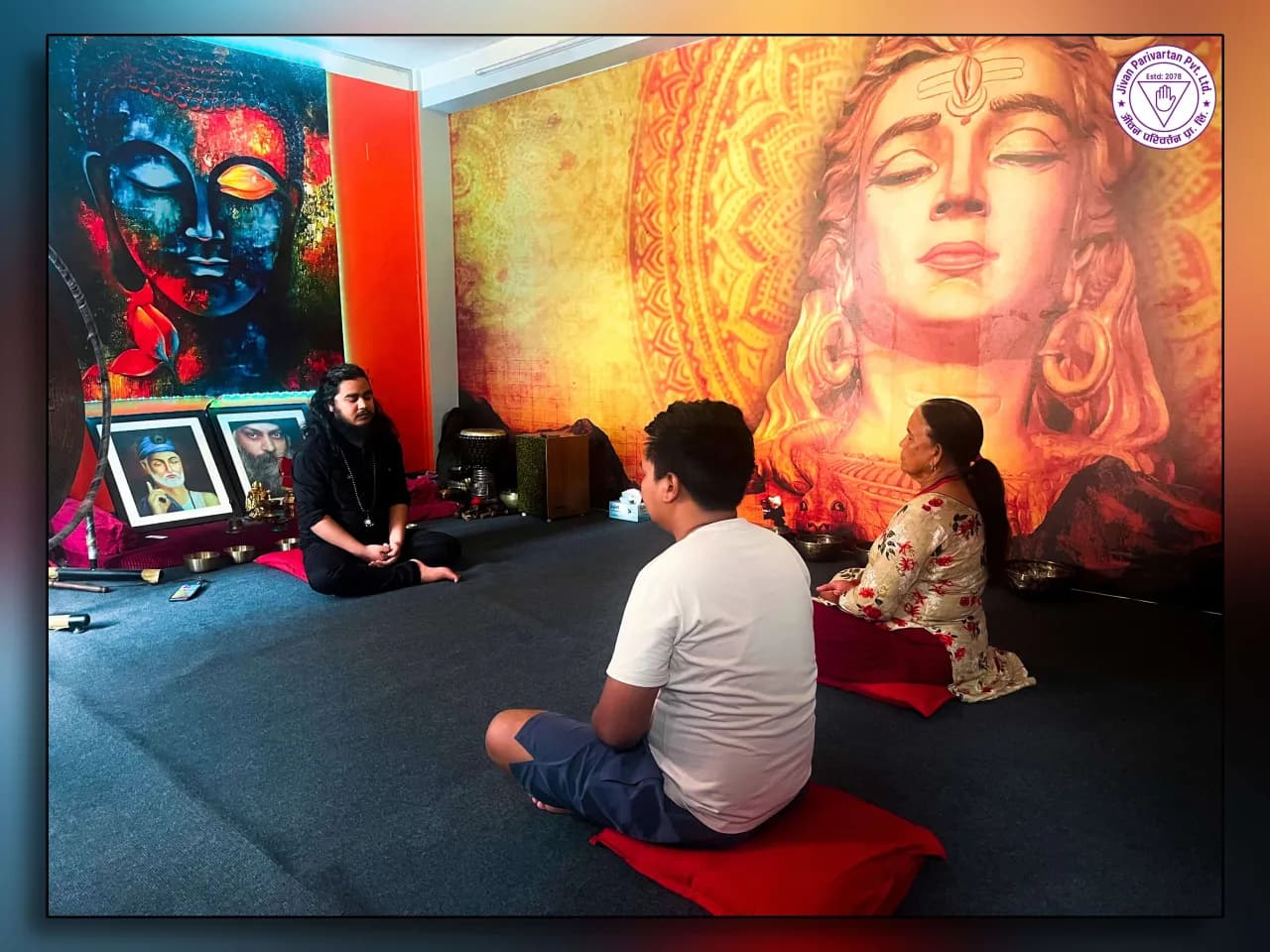
Tibetan singing bowls used in a sound bath
Mantra-Based Sound Therapy

Vedic Sound Healing in Kathmandu, Nepal

A 60-minute session in the Indian classical tradition, combining the seven chakra bija mantras with higher-overtone Himalayan bowls, at Jivan Parivartan in Tarkeshwor, led by sound healer and meditation teacher Swami Anish.

What is Vedic sound healing, and where does the tradition come from?

Vedic sound healing is the use of the bija (seed) mantras of the seven chakras, paired with tuned higher-overtone Himalayan singing bowls, to settle the nervous system and rebalance the subtle body. It is the Indian classical tradition of sound work, distinct from the Tibetan tradition, and it draws on the Sama Veda, the oldest body of sacred sound material in the world.

The Vedic understanding is that each centre of the subtle body has a corresponding vibrational signature, and that the right sound at the right place produces a physical and energetic settling that no amount of thinking, talking or analysis can match. The tradition has carried these mantras forward without interruption for several thousand years, refining the syllables until they do what they are supposed to do quickly.

At Jivan Parivartan, this work is led by Swami Anish, our co-founder. Swami Anish is a sound healer in the Tibetan tradition, a Reiki Master, a certified clinical hypnotherapist, and a meditation teacher who has spent more than a decade working with both Vedic and Tibetan sonic systems. He chants the mantras live in the session rather than playing recordings; the difference is significant.

If you have ever wondered why mantras feel different from background music, or why certain sounds make the body settle while others do not, a single Vedic session is the most direct answer you can give yourself.

The seven bija mantras used in a Vedic session

Each centre of the subtle body has a single-syllable seed sound. The session moves through them in order, from the base of the spine to the crown of the head.

ChakraBija MantraElementWhat it works with
Muladhara (Root)LAMEarthGroundedness, safety, basic stability
Svadhisthana (Sacral)VAMWaterCreativity, sensuality, flow
Manipura (Solar Plexus)RAMFireWill, confidence, digestion
Anahata (Heart)YAMAirCompassion, grief, connection
Vishuddha (Throat)HAMEtherExpression, honesty, voice
Ajna (Third Eye)KSHAM / OMLightClarity, intuition, insight
Sahasrara (Crown)OMPure consciousnessConnection with larger meaning

What happens during a 60-minute Vedic session?

You arrive at our Tarkeshwor centre, fill in a short intake form (medical history, pregnancy, any specific area you are working with) and have a few minutes of conversation with Swami Anish. He may give you a focus mantra for the day, or simply let the session do the work without instruction.

You lie down fully clothed on a comfortable mat with a bolster under your knees and a blanket if you need one. The session begins with two or three minutes of slow breathing to settle the nervous system. Swami Anish then moves through the seven chakras in sequence, starting at the root: a higher-overtone bowl tuned to that centre, followed by the corresponding bija mantra chanted slowly, two to four repetitions, then a brief silence before moving to the next.

The arc takes about 45 minutes. By the throat centre most clients have dropped into a meditative half-asleep state; by the crown you may have lost track of time entirely. The final 10 minutes are quiet integration. You sit up slowly, drink water, and have a few moments to come back into ordinary attention before you head back into the city.

Many clients book a single session out of curiosity and book a series of three or five within a week. The cumulative effect is more interesting than any single session, especially if you are using the work for sleep, stress or chakra-specific concerns (relationship work with the heart centre, expression work with the throat centre, clarity work with the third eye).

Who Vedic sound suits

  • Yoga practitioners and meditators who want to feel the chakra system rather than read about it
  • Students of our 200-hour YTT who want a personal taste of the mantra sadhana curriculum
  • People who find pure-resonance sound work too passive and want the mind something to follow
  • Those working with a specific chakra-related concern (heart for grief, throat for voice, third eye for clarity)
  • Returning singing-bowl clients who want a more attention-active variant

When to choose Tibetan instead

  • You want the heaviest, lowest resonance and gong work
  • Live chanting in the room would be distracting rather than helpful
  • You are recovering from a hard trek and want body-led, not mind-led, work
  • You are working with severe insomnia and need passive, sleep-inducing tones
  • Not sure? Try a singing bowl & Tibetan session for a direct comparison
Swami Anish, Co-Founder & Meditation Guide
Practitioner

Swami Anish

Co-Founder & Meditation Guide

Swami Anish co-founded Jivan Parivartan to bridge Eastern contemplative practice with Western therapeutic work. He is a meditation specialist, Reiki Master, sound healer and certified clinical hypnotherapist, and has spent more than a decade integrating these modalities into a single grounded approach to inner transformation. He leads the centre’s meditation programs, one-day transformation intensives and clinical hypnotherapy sessions.

For Vedic sessions specifically, Swami Anish has spent more than a decade studying the bija mantras under teachers in the Indian classical tradition, alongside his Tibetan singing bowl work. The combination is what makes the centre rare: practitioners who work in both traditions can give you an honest recommendation between them. If Vedic doesn't suit you on the first visit, he will say so and suggest a Tibetan or mixed session next time. Founder Maa Nisha Kabir also offers occasional Vedic sessions during teacher-training intensives.

Single Vedic Sound Healing Session

60 minutes at our Tarkeshwor centre, including intake, full bija-mantra arc and integration.

$50

Payment in EUR, USD or NPR. Series of 3 or 5 available on request.

Book on WhatsApp

What Clients Say

Z

Zhila Eshratabady

This was much more than a course for me. It was a journey of learning, healing, and self-discovery. I learned Reiki, meditation, and sound healing in a warm and supportive environment. I met wonderful people and gained valuable experiences that I will carry with me. Thank you for everything.

Reiki, Meditation & Sound Healing
m

myriam andrea ramirez gonzalez

Best place for learning meditation, reiki and sound healing with the best teachers in Nepal. Absolutely love my experience.

Meditation, Reiki & Sound Healing
B

Bishnu Timilsina

Maa Nisha Kabir is the best. Her meditation guidance is excellent.

Meditation guidance

Frequently Asked Questions

Vedic sound healing is sound work in the Indian classical tradition, anchored in the Sama Veda (the Veda of sacred sound). It uses higher-overtone bowls, the bija (seed) mantras of the seven chakras, and often live chanting by the practitioner. Tibetan sessions go heavier and quieter; Vedic sessions go higher and more attention-active. Both work; many clients try both before deciding.
Bija mantras are short seed-syllable sounds associated with each of the seven main chakras: LAM (root), VAM (sacral), RAM (solar plexus), YAM (heart), HAM (throat), KSHAM or OM (third eye) and OM (crown). In a Vedic session the practitioner chants or intones these in sequence, paired with corresponding higher-overtone bowls, while you rest. Each syllable has a specific vibrational quality matched to the centre it works with.
No. The chanting is done by Swami Anish; you simply lie down and receive. Some clients find that the syllables naturally arise in their own mind by the end of the session and choose to take them home as a daily practice. We send a written reference sheet on request so you can use the mantras yourself between sessions.
People who already meditate or do yoga, people who like mantra-based attention practice, people who study yoga philosophy and want to feel the chakra system rather than just read about it, and people who find pure-resonance sound work too passive. If you have completed a 200-hour yoga teacher training anywhere in the world, Vedic sessions almost always land more naturally than Tibetan ones at first.
No. The Vedic tradition is the historical source of much of what we now call yoga and Ayurveda. Bija mantras are pre-religious sound work in the sense that they predate codified religion. Clients of all faiths and no faith receive Vedic sound healing without any expectation of belief or conversion. We do not chant prayers or perform rituals during the session itself.
A full Vedic sound healing session at Jivan Parivartan is 60 minutes and costs $50. The first 10 minutes are intake and a brief settling sequence, the middle 45 minutes are the full bija-mantra and bowl arc through the seven centres, and the last 5 minutes are integration with you sitting up quietly before you head back into the city. You can book a single session or a series of three.
It pairs powerfully. Our 200-hour YTT includes mantra sadhana paired with birth-chart analysis. Many of our trainees book a series of Vedic sound healing sessions during their training to feel the bija mantras land in the body before they begin teaching them. If you are considering deeper study, a few Vedic sessions are an excellent doorway in.
Yes. Vedic sound healing combines well with morning meditation (the mantras carry into your sit naturally), with Reiki (Reiki works the energy field, sound works the subtle body), and with the One-Day Transformation Program. We do not recommend pairing it with another high-attention modality in the same visit; choose either Vedic sound or active meditation, not both back to back.

Book Your Vedic Sound Healing Session

60 minutes of bija mantras and Himalayan bowls. Single sessions or a series of three. Quick reply on WhatsApp.

Indian Himalayas Ashram Trained Instructors
Himalayan Mountain Views
Kathmandu Valley, Nepal